Semi-Occluded Vocal Tract Exercises (SOVTEs) as Prescriptive and Behavioral Voice Tools
SOVTEs: Semi-Occluded Vocal Tract Exercises are tools like lip trills, straw phonation, and cup bubbles (among many others) that create “back pressure” in the vocal tract (send pressure backwards from the mouth to the top of the vocal folds) by creating a partial cover at the sound’s exit (the mouth). The higher the back pressure, the harder it is for the vocal folds to squeeze because air is pushing them apart from the top and bottom. (It’s hard to overpower those dual pressures by squeezing between the vocal folds.) The level of “squeeze” between the vocal folds is called “transglottal pressure”. Additionally, SOVTEs shake/massage the surface of the vocal folds, which increases blood flow to the tissues and helps with healing and inflammation (Verdolini et al., 2012). Finally, using an SOVTE requires the user to create consistent airflow. BASICALLY: They are VERY SAFE (if done efficiently)! But, SOVTEs are not a “catch all”/fix all, especially in the case of pathology.
So, to summarize, SOVTEs have THREE MAIN FUNCTIONS:
Decreasing transglottal pressure: prevents “squeeze” between the vocal folds- only if done efficiently!
Massaging the vocal folds: Turbulence in the airflow shakes up the top of the vocal folds which allows fluid to disperse and swelling to decrease. “Motion is lotion”.
Encouraging consistent airflow: Many SOVTEs require visually trackable airflow (the lips vibrating in a lip trill, for example).
SOVTEs can be used prescriptively or behaviorally.
Prescriptive use of an SOVTE means that you will use your voice only while occluded. It’s a “prescription” because it would be similar to taking a medication for a problem- it might help with the symptoms, but will not heal the underlying problem/pathology (unless you are only dealing with acute swelling related to illness or a one-time heavy use). Prescriptive tasks look like:
Short-term effects to symptoms and tissue health
Can help increase blood flow and healing activities in vocal fold tissue
Non-functional; does not transfer well into singing/speaking tasks
Does not necessarily require somatic awareness/mindfulness, but those things will improve the efficacy
Examples: Vocal “exercises”/warm ups/SOVTEs in isolation- holding a sustained lip trill, blowing bubbles in a cup, gargling, etc.
Behavioral use of an SOVTE means that you will transfer your voice from the occlusion to a spoken or sung task, to change the behavior of voicing. Voice is a pattern of behavior. Therefore, to have long-term changes to pathology, you must adjust the vocal behavior. Behavioral tasks look like:
Long-term effects to symptoms and tissue health
Functional; transfers directly into singing/speaking tasks
Requires somatic awareness/mindfulness
Examples: SOVTEs transferred into open vowels/words/phrases; “Gestalt” principles (whole is greater than the sum of its parts); pattern changing exercises in singing/speaking tasks
Examples of SOVTEs from HIGHEST to LOWEST pressure:
Image below taken from “Intraoral pressures produced by thirteen semi-occluded vocal tract gestures” by Maxfield et al.
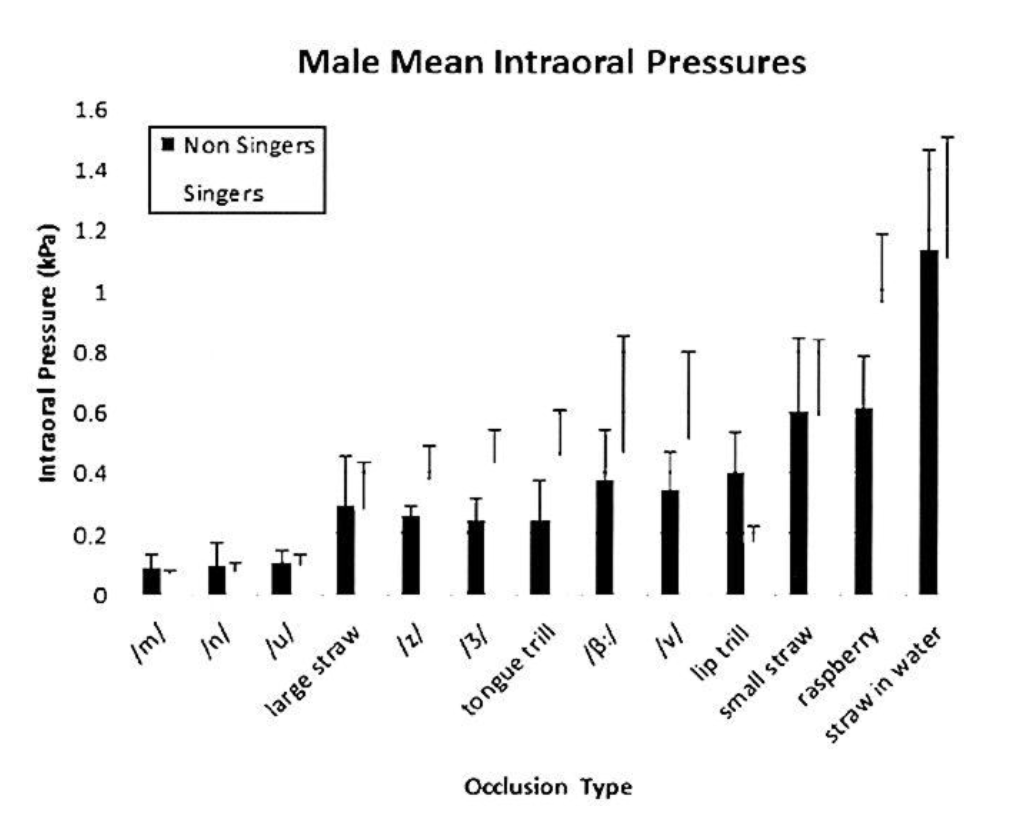
The tools below are rated both by the data from the above article and anecdotal evidence:
Vent mask (most back pressure)
Gargling
Cup bubbles (small straw)
Cup bubbles (big straw)
Straw phonation (small straw)
Lip trills
/v/
Tongue out trills
Straw phonation (big straw)
/u/ Y buzz
/n/
/m/ (least back pressure)
Orienting to sensation (“laryngeal sensation”) using different SOVTEs: In order to determine the behavioral efficacy and safety of the semi-occlusion you’re using, you must be aware of sensation in your larynx during phonation (voicing). Try each exercise above. Notice: what do you feel in your throat? Ideally the answer is “nothing” or “vibration”. If you feel other sensations like pain, tickling, burning, itching, or the urge to cough, it indicates an inefficiency.
What is your “preferred” SOVTE? Which of the above exercises gave you the least laryngeal sensation and was the easiest to use? This might change day to day: reassess regularly.